
Connecticut ACDA 2026 Fall Conference Keynote Sessions with Dr. Jennifer Sengin
Conducting with Style: Envisioning Gesture as Leadership
Envisioning Our Musical Home: Building Community in Choir
Student Conducting Master Class
Transitioning from melody to harmony, unison to part singing, aural to visual, can be challenging for upper elementary and middle school students, yet is critical for the preparation of choral singing. Where to begin; and how?
Sequential strategies to develop part-singing abilities will be shared, first with the ear, utilizing bass lines, partner songs, vocal chording, rounds and canons to help strengthen aural recognition, and then, by eye, through sight-reading, utilizing bass lines and two-part choral arrangements. Participants will be actively engaged throughout the presentation, experiencing each component. A handout will be provided, as well as links to audio recordings.
Lillie Feierabend is known for her work with young children and instilling a love of music within them. She has been an early childhood and general music educator for over forty years and a choral conductor for twenty. She has been honored by two school districts and CMEA for her inclusive and innovative music programs. She conducts regional honors choirs, leads weeklong workshops, and mentored 23 student teachers. She is a frequent clinician, presenting over 400 thoughtful and lively workshops. Lillie is a member of many professional organizations, and has never met a crossword puzzle she did not take pen to.
Through a curated selection of published compositions by the presenter himself, Chris will guide participants through thoughtfully designed music that reinforces technique while inspiring expressive, meaningful performances. Each piece is approached as both an artistic and pedagogical tool, offering opportunities to deepen tone, tuning, text connection, and ensemble cohesion. By aligning rehearsal strategies with repertoire that is both accessible and musically rich, conductors can create a seamless bridge between skill-building and artistry, where every note contributes to a vibrant and compelling musical experience.
Chris Maunu is the Artistic Director of the Pacific Youth Choir. He also spent almost two decades in the classroom, earning 4 GRAMMY Music Educator of the Year Finalist honors and many other accolades. Maunu has conducted choirs at 14 major conferences of National and Regional ACDA and Music Educators Association events, and led the 2025 National ACDA 11-12 Honor Choir. Chris is in high demand as an All State clinician and speaker across the U.S. and internationally. He is an award winning composer and Editor of the Pacific Youth Choir Choral Series with Pavane Publishing. Maunu is the NWACDA Children and Community Youth Choir Chair and affiliate faculty at Portland State University. More at chrismaunu.com.
This session explores how choral educators can redesign ensemble structures to create meaningful, accessible, and joyful music-making experiences for students who may not thrive in traditional audition-based settings. Participants will identify structural barriers to participation and explore five guiding principles: Accessibility, Belonging, Collaboration, Student Voice & Agency, and Joy & Purpose. Through interactive activities, peer-mentor scenarios, rehearsal strategies, and repertoire exploration, participants will develop practical approaches for creating flexible, inclusive ensembles. Attendees will leave with strategies they can immediately implement and an action plan for rethinking one structural barrier in their own music program.
Jennifer Hartnett (she/her) is the Director of Choral Activities at Norwood High School, where she has served since 2015. She conducts Madrigals, Concert Chorale, and OverTones and teaches Music Theory. Previously, she taught choral music and general music in the Rockland Public Schools. Her ensembles regularly earn Gold and High Silver ratings at MICCA, while her students are selected for district, state, and ACDA honor ensembles. Jennifer holds degrees from Bridgewater State University, Stephen F. Austin State University, and Longy School of Music. She serves as Auditions Coordinator for SEMMEA and Secretary for Massachusetts ACDA.
Parking-lot Bach? Gloria + puppetry? Planetarium polyphony? Lauridsen with shadow art? This session is aimed at exploring wild, new ways to craft memorable, boundary-pushing experiences of choral music. What totally unusual collaborations, technologies, settings, formats, and locations have you not yet considered? How might we imagine programming beyond familiar templates - the Christmas Concert, Spring Concert, Broadway Concert, Nature Concert - and fundamentally rethink what else a choral event can be?
Michelle Horsley is the Music Director for The Choir School of Hartford (RSCM), Dean of the Greater Hartford Chapter of the American Guild of Organists, and Director of Music at Trinity Episcopal Church in Hartford. Michelle holds degrees in Organ Performance (BM) and Sacred Music (MM) from Stetson University and Duquesne University and now resides in Hartford's West End. Originally from Florida, Michelle has also lived in Spain, Germany, and Mexico. She frequently composes, teaches, leads workshops, and performs around New England and most recently has been exploring vocal improvisation within the circle-singing tradition. More information about Michelle can be found at www.MichelleHorsley.com.

Discover ways that the repertoire can serve our ensemble, instead of the other way around.
If you've ever found yourself struggling to make the repertoire that you have work for the ensemble that's in front of you, you're in good company! Whatever your concerns about repertoire selection may be, this workshop is for you. My goal is to gather choir directors of all kinds, explore repertoire selections together, discuss potential limitations, and share ideas that can make repertoire work for us. This workshop will help us discover that more is available to us than we may realize.
Brian Jones is a music educator, published composer, and singer based in Connecticut. He teaches choir at Canton Middle School and Canton High School. He is an active guest conductor/clinician, and vocal coach for choirs and private voice students. As a composer, Brian's music spans from advanced/professional choral music, to repertoire that is both versatile and accessible to young and emerging choirs. Brian received his BA in Vocal Performance and CT Teaching Certificate from Central Connecticut State University, and his Masters Degree in Music Education from the University of Hartford's Hartt School of Music.
Experience Swahili choral music through repertoire learned firsthand at the Mziki Choral Festival in Kenya.
Participants will sing several pieces while exploring their history, language, cultural context, and approaches to teaching them authentically. The session will also highlight music education and advocacy in Kenya, including the development of El Johns Music School in Nakuru. Participants will leave with new repertoire, practical teaching strategies, and opportunities to connect with Kenyan musicians visiting the United States in May, laying the groundwork for future musical collaborations.
Rebecca Saltzman is Choral Director at Simsbury High School, where she directs five curricular ensembles, three a cappella groups, and the Gertrude Banks Gospel Choir. She also serves on the adjunct faculty at The Hartt School, teaching courses in secondary choral music education. Saltzman holds degrees in Music Education from Florida State University and Ithaca College and is a frequent festival adjudicator, conductor, and conference presenter. She currently serves as the ACDA Eastern Division Vocal Jazz and A Cappella Repertoire and Resources Chair and was named a 2026 Grammy Music Educator Award Quarterfinalist.
Elementary and middle school choirs can sing more challenging and meaningful music if you put down the octavo. Teaching choir music by rote and with lots of movement allows children of all ages and abilities to be successful. You will walk out of this presentation with 8 choral pieces that have won the hearts of my students. We will dive into what makes these pieces so well loved and the teaching strategies that will make them successful. After singing and moving our bodies, your “swag bag” will contain google slides for all 8 pieces along with video examples of choirs performing these pieces. Rehearsal and planning time are short these days, and extra school duties are plentiful! Treat yourself to choir music that inspires and challenges you as a conductor and educator.
Kate Smallidge teaches K-5 general and choral music at Lake Street School and Center Road School in Vernon, Connecticut. She has taught general music, beginning instrumental music, and middle school choir for the past twenty-four years. She earned her bachelor’s degrees from the University of Connecticut and a master’s degree from the University of Rochester, Eastman School of Music. Ms. Smallidge conducted The Main Street Singers, a children’s choir in New Britain, Connecticut from 2011-2014, and was recognized in 2014 as the Connecticut ACDA Outstanding Young Choral Director of the Year. In support of future music educators, Ms. Smallidge works closely with the University of Connecticut music education program.
Elementary choir directors: does keeping every singer engaged feel like a moving target? This hands-on session tackles that head-on. Try attention-grabbing warm-ups that focus energy before rehearsal starts, "change of pace" strategies to re-engage singers mid-lesson, and a student-led activity where singers create their own game for a choir song — then teach it to the whole ensemble. Walk away with a ready-to-use toolkit, a felt sense of how each strategy works in real time, and a framework for knowing when to use them with your own singers.
Kristin Lafferty is the music teacher at Nayatt Elementary School in Barrington, Rhode Island, where she teaches students in kindergarten through third grade and leads the Nayatt Third Grade Chorus. In addition to her work at Nayatt she also serves as an associate music director at Newport Sings.
Kristin is actively involved in the choral community both locally and regionally. She currently serves as President-Elect of the Rhode Island chapter of the American Choral Directors Association (RIACDA), having previously held the role of Repertoire & Resources Chair for Elementary Choirs (2023–2025). Kristin holds a Bachelor of Arts in Music Education from the University of Rhode Island.
Learning to know oneself—one’s musical and personal strengths and growth areas—and having them assessed by others is essential when preparing to enter the choral profession. The more we can look inward, the better we can contribute to a shared purpose, foster community, collaborate with colleagues, and recognize strengths and challenges in our singers to help them thrive. Yet, as one moves through a career, it can be challenging to “look in the mirror” objectively. In this panel, musicians in early, mid-, and late-career stages will reflect on self-assessment in collegiate, teaching, community, and music-and-worship settings to bring out their best selves, and in turn, their singers’ best selves.
Cara Bernard is Associate Professor of Music Education at the University of Connecticut, where she teaches courses in choral and elementary methods and curriculum. Cara collaborates with choral and music education associations nationwide to write curriculum and lead festival performances, adjudications, and workshops. Previously, Cara was conductor of the Count Me In program at Carnegie Hall, where she designed and implemented a middle school choral curriculum. Additionally, she worked with the Young People’s Chorus of New York City™, bringing a choral experience to over 1,000 children. Cara serves on the editorial board of the International Journal of Research in Choral Singing, and is editor of Visions of Research in Music Education. She sings with Seacoast Choral Artists, and is Immediate Past President of Connecticut ACDA.
Ellen Gilson Voth is Director of Choral Studies and Visiting Assistant Professor of Music at the University of Connecticut, where she conducts the Chamber Singers, Concert Choir and Festival Chorus, teaches undergraduate conducting and co-teaches the conducting seminar for graduate students. Voth’s conducting spans professional, collegiate, community and secondary-level ensembles throughout the Northeast. She is active as a guest conductor, festival clinician and presenter at conferences across the US, particularly on the integration of ear and movement in the choral rehearsal and how the creative process informs conductors’ score study and interpretation.
A regularly commissioned composer, Voth’s compositions and arrangements are published by ECS Publishing, Graphite Publishing, Oxford University Press, Walton Music, Colla Voce and Santa Barbara Music Publishing, and have earned national awards from The American Prize and from ACDA.
Voth has served on the Board of CT-ACDA and the Board of Choral Arts New England. Her DMA is from The Hartt School, Univ. of Hartford, where she received the Regents’ Honors Award for graduate students.
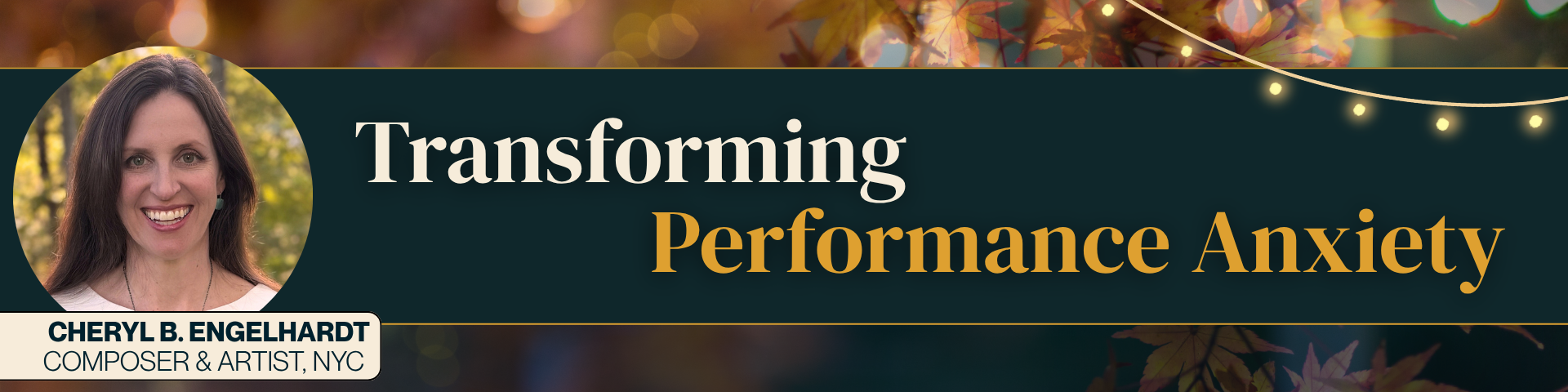
Performance anxiety affects musicians at every level, and choral directors are uniquely positioned to address it both in themselves and the singers they lead. This interactive session explores how fight, flight, freeze, and appease responses influence performance and how past experiences can shape the nervous system’s response to being seen and heard. Through humor, guided reflection, breathwork, grounding, visualization, and reframing, participants will learn practical strategies to regulate performance anxiety in real time. Directors will leave with tools to build confidence, deepen connection, and create rehearsal and performance environments where singers feel safer taking expressive and musical risks.
Cheryl B. Engelhardt is a two-time GRAMMY®-nominated composer, recording artist, speaker, and certified trauma-informed coach whose music spans albums, choirs, theater, commercials, and meditation. Featured in Forbes, GRAMMY.com, and People, she has performed with Sting and Pentatonix and spoken at SXSW, ASCAP Expo, and music industry conferences nationwide. Cheryl leads workshops and retreats through her Rooted Results™ methodology, combining nervous system regulation with practical tools for creative careers. She serves as Chair of Contemporary/Commercial Repertoire for ACDA’s Eastern Division and as a Governor for The Recording Academy’s New York Chapter, advocating for musicians and creators.